


‘That agony returns’: What Coleridge’s ancient mariner can teach us about the Long Covid brain re-trainers
By Guest Writer Ted Monroe
Audio on Substack
We are pleased to host writer Ted Monroe with a wonderfully incisive article on the recent controversial article ‘The Painful Truth about Long Covid’ by Alan Levinovitz.
Ted’s essay on Long Covid, alongside 12 essays on disability, illness and care, is also featured in a new edition of Virginia Woolf’s masterpiece ‘On Being Ill’. To celebrate, we are doing a giveaway* of ‘On Being Ill’ signed by Ted! Just comment VIRGINIA to enter.
You can check out Ted’s excellent Substack ‘The Art of Convalescence’ here.
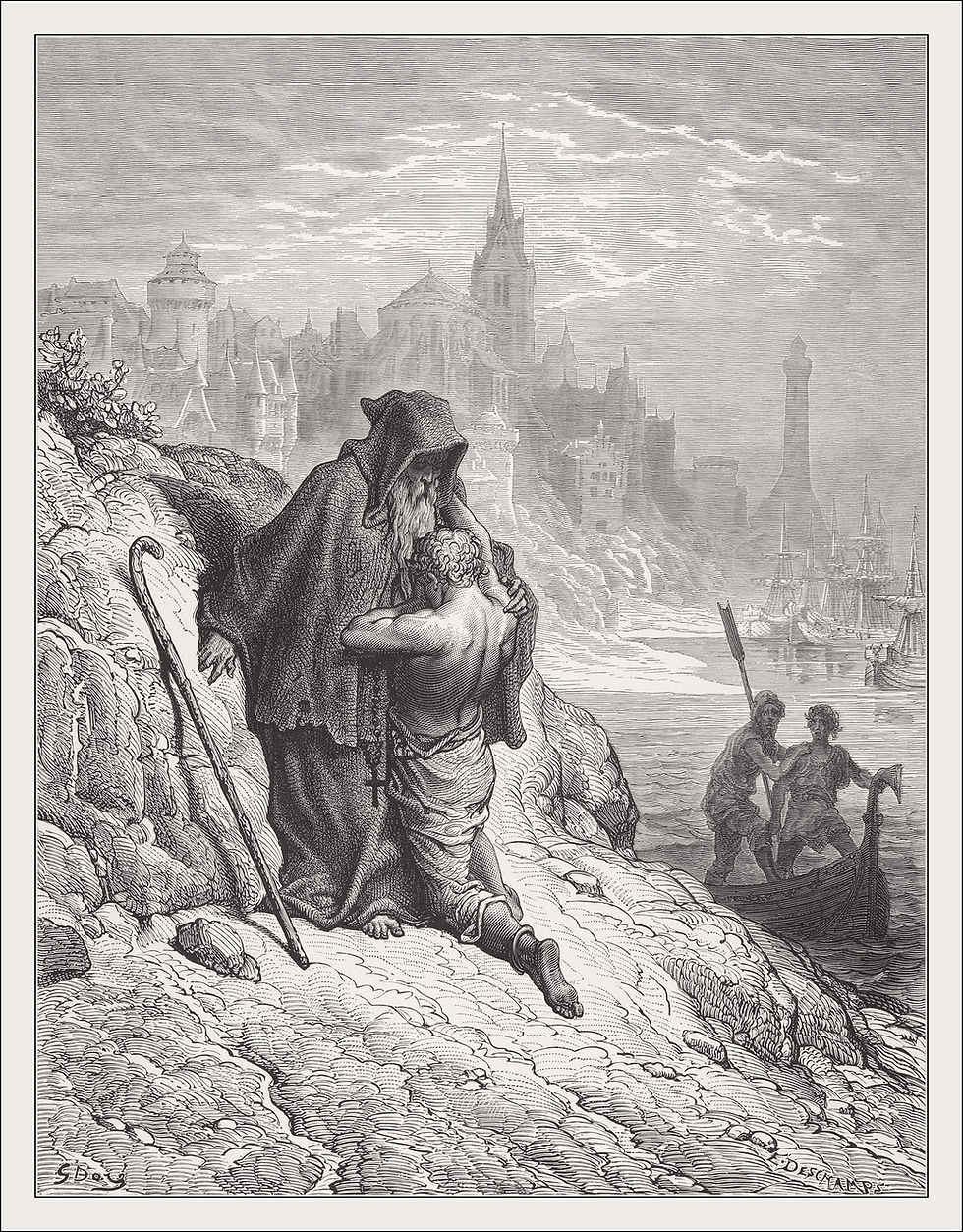
One of Gustave Doré’s 1877 engravings for a German edition of Coleridge’s ‘Rime’. This depicts the moment the mariner returns home and begs a local hermit: ‘'O shrieve me, shrieve me, holy man!'
Forthwith this frame of mine was wrenched With a woful agony, Which forced me to begin my tale; And then it left me free. Since then, at an uncertain hour, That agony returns: And till my ghastly tale is told, This heart within me burns.
In Samuel Taylor Coleridge’s great poem, The Rime of The Ancient Mariner, the old mariner hauls aside a man on his way to a wedding and captivates him with the tale of his catastrophe-ridden voyage to the south seas, undertaken many decades earlier.
After the mariner shoots an albatross for no apparent reason, a series of nightmarish disasters unfold – the ship is knocked off course, the crew dies of thirst and starvation, the mariner lives on to see their ghosts haunt the ship, ‘a thousand thousand slimy things’ pursue him from ‘the rotting sea’ and he is visited by the ghastly spectres of Death and Life-in-Death who play dice to decide his fate.
For much of the poem, the mariner is made to wear the dead albatross around his neck, a mark of shame for a pointless murder. But in a moment of absentmindedness, he ‘blesses’ the supernatural snakes, apparently ‘unaware’ of what he is doing; the albatross falls from his neck, he can pray again, and all this paves the way for kind of uneasy redemption, though there is more misery to come on the journey home – plagued, as he is, by the vengeful Spirit of the Deep which purses him across the ocean.
After being alone for months on end and enduring just about every form of torment Coleridge could conjure up, the mariner reaches the shores of his home country. But this is not quite the end. Beset by guilt and harrowed by the misery he has lived through, he feels compelled, like some early Christian preacher now converted to the true faith, to travel to new lands and tell his story to every third person he meets:
I pass, like night, from land to land; I have strange power of speech; That moment that his face I see, I know the man that must hear me: To him my tale I teach.
This is why the mariner is ancient: Coleridge intended that the mariner’s troubles had befallen him as a young man; it is in those long, ensuing years that he has spent time as penitent and preacher.
What has any of this go to do with brain retraining and recovery stories? Coleridge makes an acute psychological observation here: those who have suffered terribly for years and eventually reach firm ground often need to revisit their experience, to explain it to others and, perhaps more importantly, to themselves. They are trying to understand an experience that confounds understanding. They cannot completely move past it. Like the mariner, the need they feel to transmit their tale of woe is in no small part down to the isolation and the despair they experienced in the depths of suffering, a kind of retrospective compensation for years of silent anguish. Crucially, the repeated telling of the tale becomes a ritual, a way of exorcising the horror that never properly disappears and so needs a kind of ongoing ablution.
Coleridge himself was no stranger to chronic pains, which by 1798, the year in which he composed his sea-ballad, had come in many forms (joints, gut, head) and were often alleviated by opium, to which he became addicted. In meeting William Wordsworth, the year before, a friendship that would, it is no exaggeration to say, change the course of English poetry, he had also reached port after years of exilic wandering; perhaps the most amusing example of which was a fanciful bid to escape debt and a failed romantic relationship by enlisting in the Light Dragoons under the fake name of Silas Tomkyn Comberbache, only for his brothers to have him discharged on grounds of insanity. An experience nursing a soldier with smallpox during his military service ‘may well’, his biographer writes, ‘have contributed something to the hallucinations of the Ancient Mariner’. Sadly, as in art, life: Coleridge would be plagued by guilt, shame, sorrow and loneliness for the rest of his relatively long life, to say nothing of the many physical ailments that he bore all the way to the grave.
In one of the most famous passages of the poem, the mariner recalls that, lost in the vastness of the ocean, with all his shipmates dead, he was
Alone, alone, all, all alone, Alone on a wide wide sea! And never a saint took pity on My soul in agony.
How those lines speak to the desperate experience of chronic solitude that the Long Covid or ME patient lives with! And in these lines, we don’t just hear a pitiful lament. The mariner feels a deep and abiding sense of shame for having been marked out for this dreadful fate and guilt for the part he played in it, for having survived where his crew perished. Was it individual responsibility – the shooting of the albatross – that caused all the ghastliness, or would it have happened anyway, despite his trigger finger? Was he the pawn in some abstruse cosmic game we never learn the nature of?
We never know, and neither does he, and it is perhaps this ambiguity that impels him to repeat his tale endlessly, in the hope that one day it might make sense.
This ambiguity will be so familiar to any post-acute viral patient who has tortured themselves by flirting with the notion that they are, to some degree, responsible for the Hell that has been unleashed on them. As we know, the brain retainers believe that there is culpability at the level of the individual. How much varies from trainer to trainer, but it is a question that they can never fully answer, which is why it must be revisited so often.
Just as the mariner feels a deep shame, so those who have recovered might also feel shame that chronic illness marked them out, shame that they could not overcome it for years, guilt that they made life immeasurably more difficult for their family.
The pain, the isolation, the misery, the guilt, the shame, the psychic injury, and the sheer nightmarish weirdness of what they went through is perhaps why so many people who have recovered from chronic conditions cannot let go of their suffering. It is not surprising that many ‘brain retraining’ programmes have been set up by former ME and Long Covid patients. Similarly, people who credit these programmes with their recovery are often keen to appear on podcasts (with sad-looking cacti in the background) to proselytise their arguments.
Some of these people seem genuinely compelled to help others avoid their fate. (Others seem to me pure charlatans.) But they are also haunted by the strange and paradoxical desire to reconcile those years of exile by re-living them time and again on internet forums where they evangelise and offer guidance to desperate people eager for good news stories – like I was, and much to my detriment. Again, Coleridge’s mariner is instructive. After he has finished his tale of woe, he cries out,
O Wedding-Guest! this soul hath been Alone on a wide wide sea: So lonely 'twas, that God himself Scarce seemèd there to be.
But now he has found God and recommends that they both head to church.
Many people reading this may be familiar with a recent article on Long Covid recovery stories and ‘brain retraining’ published in Wired by the professor of religion Alan Levinovitz. In this piece, Levinovitz argues, somewhat bumptiously, that the sick patients who vehemently criticised ‘brain retraining’ as a valid treatment were exhibiting behaviour typical of religious belief: they believe, he argues, so fervently in a biological cause of illness that they neglect to consider non-pharmaceutical, mind-body treatments, such as ‘brain retraining’ that could actually help them, and crucify anyone for suggesting these practices.
Now is not time to exhume that argument, which, for many of us, has been laid to rest by virtue of our having tried brain re-training and gutted our health, but could I politely suggest that he might have considered the opposite: that the truly religious response might actually come from the Damascene converts who have undergone a miraculous recovery and are now trying to preach the truth of their experience to the rest of us. Ironically for a professor of religion, Levinovitz is surprisingly blind to the converts in his midst – and perhaps to his own impulses.
And, if you’ll allow me the briefest of digressions, might I also suggest that, when one is in the trenches, one needs to fight: that is, the impassioned responses Levinovitz objected to so much are not borne from a religious disposition, but one of survival.
When he reaches home, the mariner begs a hermit to absolve him of his sins: 'O shrieve me, shrieve me, holy man!' One of the things that persuades me that a religious sensibility in the brain retrainers is at play is the kind of quasi-religious language used. Brain retraining programmes and recovery stories so often issue pat moral advice. Recovery, we hear, ‘teaches us who we truly are’; it ‘reconnects us with our true selves’; it proves that ‘life is a blessing’; it is (hold your nose) ‘beautiful’. Such people claim to have emerged from the chrysalis of Long Covid and transformed into more authentic people by way of spiritual self-examination. Even Coleridge, usually so original, slips into clichéd morality mode towards the end of his ‘Rime’ when the mariner concludes that
He prayeth best, who loveth best All things both great and small; For the dear God who loveth us, He made and loveth all.
This had an amusing parallel in real life, where Coleridge could not bear to set traps for mice: to do so would be ‘a foul breach of the rites of hospitality!’ He did not wish ‘to assassinate my too credulous guests’. But Coleridge isn’t content to finish with this neat little parable about the interconnectedness of man and nature – what he had termed the One Life a few months earlier. The wedding guest, after hearing the mariner’s tragic tale, wakes up the next morning ‘a sadder and a wiser man’ – the final words of the poem. Those who recover so often feel obliged to bestow their wisdom on others, but they must also honour their own sadness that they perhaps still live with, and, understandably, need to exorcise.
The mariner lives to tell the tale. But his still crew lies at the bottom of the ocean. We need funding and research, not brain games, to repatriate us to the lives we long to get back to.
*Giveaway Terms: The giveaway opens on 5 July 2026 and closes at 11:59 pm BST on 12 July 2026. To enter, comment "VIRGINIA" on this post. This giveaway is running across multiple platforms. You can enter once on multiple platforms - giving you multiple chances to win!
One winner will be selected at random and contacted by direct message (or by reply on the relevant platform). The prize is a signed copy of the new edition of ‘On Being Ill’ by Virginia Woolf, featuring Ted Monroe's essay on Long Covid. This giveaway is not sponsored, endorsed, administered by, or associated with Instagram, Facebook, X, Bluesky, or Substack.


Comments