


101: 01. Psychologisation
Updated: 6 hours ago
Definitions, Distinctions, and Why It Matters
Audio on the Substack Mobile App
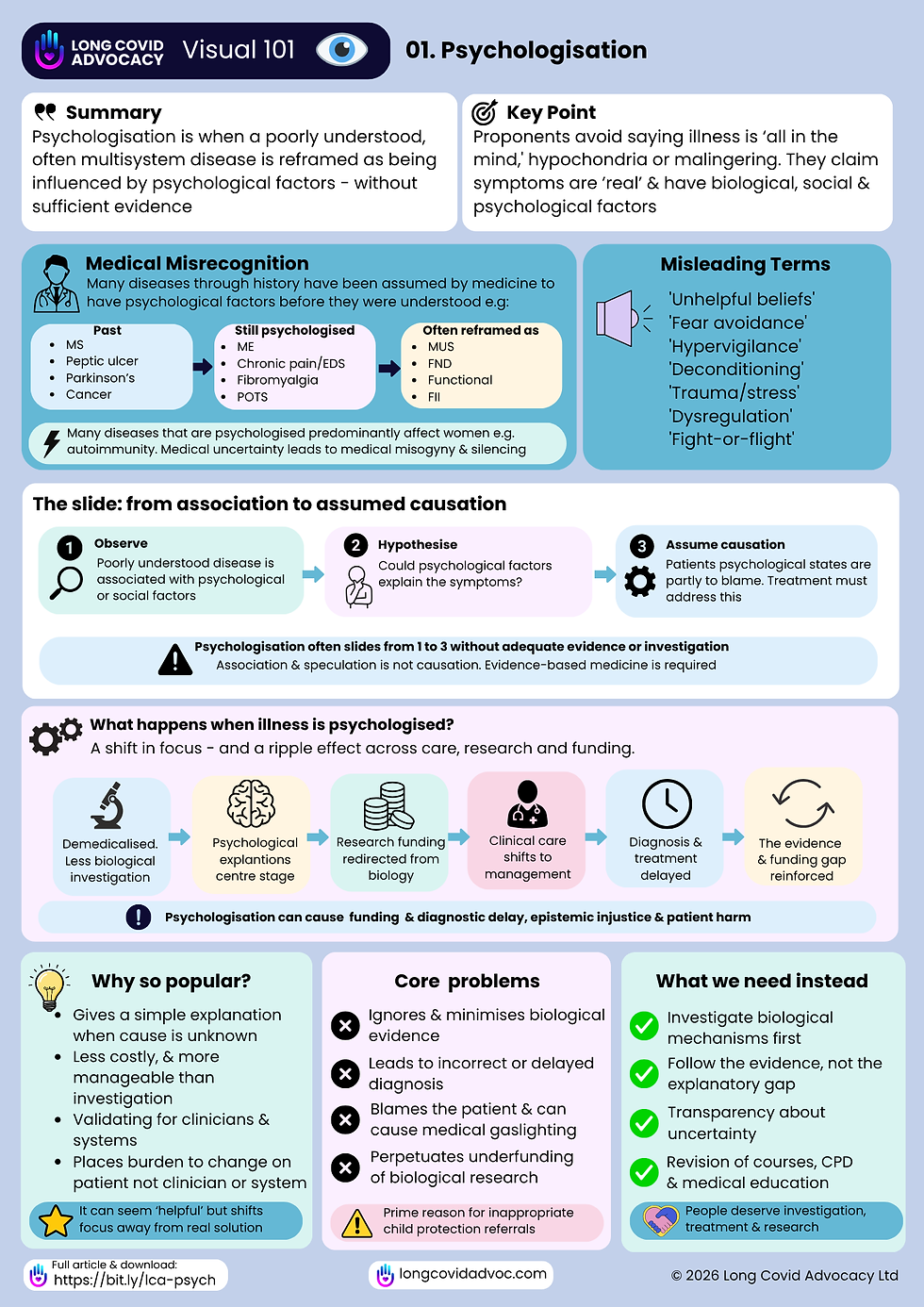
Infographic Published: 13/10/26. Independently reviewed by 3 people with lived experience. Not created with AI.
In philosophy or any interpretive endeavour, it is vital that we go back to first principles and definitions. One of the stickiest areas in the community we have to deal with is the psychologisation of Long Covid, ME and other poorly understood medical conditions.
We have seen in recent discussions disputes and denials as to what psychologisation is and if one psychologises, especially in the Mendenhall fiasco. Therefore, we thought it would be helpful to go back to basics in explanation, so the community can have an easy resource to source.
If we are clear on what psychologisation is, we can recognise it, argue coherently and also question to see if others understand it. This is important as it is not those who claim to psychologise the illness that is usually the problem; it is those who do psychologise but then claim not to. In fact, no one will put their colours in the psychologisation team as it is soooo toxic.

What Psychologisation is
Psychologisation is the interpretive move that reframes a primarily biological disease process as being meaningfully driven, maintained, shaped or influenced by psychological or social factors.
That’s it. It’s that simple.
We also have to acknowledge that there is a greater chance of seeing stars in the sky at noon than those who psychologise, presenting clear mechanistic evidence for their theory. It’s an important point we need to ground ourselves in - these are just models, theories. They might make coherent sense and sound expansive and promising or even compassionate, but they are conjecture, speculation, glitter in the wind.
As noted in previous articles, (Not ALL in your Head? Think Again and our Cognitive Therapies series) it is important to realise that psychologisation does not require accusing patients of faking (hypochondria), saying symptoms are “all in the mind”, or denying the illness is real. Modern pyschologisation almost NEVER does these things. Remember, this is a category error and a smoke screen to usually prop up the egos of those justifying they aren’t psychologising.
Muddy Waters
We see psychologisation in the medical and alternative medicine world (lucky us!! - irony), usually through the misuse of holism. There are several reasons why we are stuck in this Mobius loop but the predominant one is that psychologisers use a slippery technique to validate their claims; of truths rooted in reality that lead them to speculate a might what-if? It’s a mighty land grab, or in more fancy terms epistemic trespass.

It is these realities that they overextend: that inequality leads to poorer health outcomes; illness affects mood; trauma has impact on lives; stress interacts with the body.
These are uncontroversial, but the slipperiness happens when a massive what-if is proposed - that these psychosocial factors are drivers in symptoms and the disease mechanism.
The Maintenance Move
The contemporary version of psychologisation, perfected by the BPS (biopsychosocial) school associated with figures like Simon Wessely do not deny the biology. Instead, it proposes a model like this: a virus triggers symptoms, but ongoing symptoms are meaningfully influenced by factors such as unhelpful beliefs, hypervigilance, deconditioning,
fear avoidance, maladaptive coping, trauma, stress, ACE (adverse childhood events) etc.
But notice what happened—the disease was real in the beginning, continues to play out in the body, but psychosocial factors (i.e. the patient) are elevated beyond their impact to be meaningfully relevant. And we know that this model has been elevated to the point where it dominates healthcare pathways and cultural perception.
But Honest Guv, I’m Not Saying It’s ALL Psychological
And here we get to a sad and complex issue in the community - denial and delusion. It is a depressing state of affairs that we have those within the community who claim to be allies but who dabble in psychologisation. We have seen this repeatedly Mendenhall, Medinger, Riggs, McKie, Bolt etc.

One can say: it’s real, there are biological factors, it’s complex, I believe the science, it’s multi-system, and still psychologise. This is usually through tinkering with mind-body theories around safety and danger.
It is crucial to realise that if you are proposing that psychological factors are influencing symptoms in the absence of robust biological evidence that the disease has resolved, you are psychologising.
If you are framing recovery or improvement of symptoms as dependent on correcting cognition, emotions or behaviour, you are psychologising.
If you are placing the burden of disease perpetuation (fully or partially) on patient psychology, of being stuck in a state of fight and flight that needs to be calmed by psychological methods rather than unresolved pathophysiology, you are psychologising.
One can believe all the physical research, and still psychologise.
One does not have to be Simon Wessely, or one of the BPS crew, to psychologise and even they deny it!
Yet, it is very rare to see realisation or acceptance; the psychic wound is too great to hold.
The Key Diagnostic Question
It is important to ask this: if we discovered tomorrow that there was clear, effective medical treatment that cured people, based on clear pathology, would your model collapse?
If the answer is yes, then your model rests on false speculative assumption, and it is this assumption that patients are contesting. We have seen this time and again in conditions like asthma, stomach ulcers, and lupus - once the mechanism is discovered, the psychosocial factors of explanation vanish.
It is why we only see psychologisation in contested and poorly understood illnesses. There is a gap, and psychologisation fills it. Just look at a brain retraining website; look at the illnesses that fill the MUS (medically unexplained symptoms) definitions in medicine - they only contain illnesses that are poorly understood and lack prestige.

Now we know what causes MS and Parkinson’s, no one is claiming that these diseases should be managed by psychological or behavioural methods (fully or partially)!
It is arrogance; it is hubris, and one could argue stupidity that pours in psychologisation instead of acknowledging uncertainty and carrying on the quest of discovery. And it’s worth saying that this gap predominantly affects illnesses that affect women.
The Harm
It is easy to look at psychologisation and be seduced by its promise of ‘holistic’ ‘patient-centred’ care. But it does three predominant things that cause harm:
It redirects research funding away from biology.
It alters clinical tone from investigation to management.
It subtly transfers responsibility from system failure to patient behaviour.
It is why, as a battle line, it is so important to defend and to identify when it is happening. It produces a system where patients are believed - but not fully. Where illness is acknowledged but demedicalised. It is why it is so hard to spot and so easy to deny. It looks sophisticated; it looks plausible; it looks holistic and caring, but it is not - it is violent.
The Slide
Remember the slide. What should happen is that one:
Observes correlation (idea)
Proposes a theory (hypothesis)
Demonstrate the causal mechanism (proof)
That’s the essence of the scientific method. But psychologisers often slide from 1 to 3 without actually doing 3. Instead, we get speculative pseudoscience, usually about being stuck in fight and flight.

This is the structural issue: because models that psychologise are framed as holistic and integrative, they assume they can skip proof. They assume they only require plausibility. We are back to the Mobius loop, as this plausibility is often inferred from the absence of a fully mapped biological mechanism, the chronicity of symptoms and that distress accompanies long-term illness that medicine doesn’t understand and stigmatises. It is, in essence, bad, incomplete science.
The Bottom Line
So we’ve determined one doesn’t have to be Simon Wessely or Phil Parker to psychologise. It is not claiming someone is mentally ill. It is assuming, without sufficient evidence, that persistent symptoms are meaningfully shaped, influenced or maintained by psychological processes. And miraculously, can be fixed and improved by the program you want us to engage in and often pay for. Because let’s face it, we are usually encouraged to participate in programs that espouse psychologisation if someone has skin in the game. That can be professional, monetary, or reputational.
Psychologisations Reach
It is important to note that diseases that are poorly understood, often multisystemic and chronic, are at the highest risk of psychologisation, especially those that affect women. Yet, the reach of psychologisation is pernicious and can be attributed to any disease. Even today The Guardian reported on a study that demonstrated that women with autoimmunity are 74% more likely than men to be told that their symptoms are psychological. Let’s leave the final word with Shaista Tayabali, patient and co-author of the study:
The fact that females reported higher rates of psychiatric and psychosomatic misdiagnoses than males … suggests that historical gender biases remain a challenging aspect of the diagnostic journey … Although labels such as hysteria are outdated, and fortunately rarely used nowadays, as women we still often have a harder time having our symptoms believed and therefore addressed accurately.
In our next 101 we will look at the Biopsychosocial model and how psychologisation creeps into healthcare with this framing.
If there is anything you would like to see covered in our 101 series, just leave a comment!
List of Programs and Approaches that Psychologise
Brain Retraining/ Neuroplasticity Programs
The Lightning Process, The Gupta Program, DNRS (Dynamic Neural Retraining System), Joe Dispenza’s Courses, Alex Howard’s RESET, Raelan Agle’s Brain Training 101, ANS Rewire, Be Your Own Medicine.
Talk Therapy/Psychological Counselling Models Used Clinically
CBT (Cognitive Behavioural Therapy), Mindfulness-Based Therapies, ACT (Acceptance and Commitment Therapy, Psychoeducation/supportive counselling that teach ‘active recovery’ mindsets.
Behavioural & Rehabilitation Approaches Often Framed Psychologically
GET (Graded Exercise Therapy), Activity management or pacing framed as behavioural adjustment (often called pacing up).
Mind-Body and Stress Focused Approaches
Pain Reprocessing or Repressed Emotion Trauma Models, Lifestyle and ‘nervous system reset’ camps, EMDR, Polyvagal Theory - neuroception of safety vs danger, Breathwork framed as stress modulation; Bolt’s 360 Mind, Body, Soul/ Rest, Repair, Recover; On the Mend by Harry Boby.
Any more suggestions on methods that psychologise, please add in the comments, and we will add to the list!


Comments