


Psychologisation 101 Update
Infographic
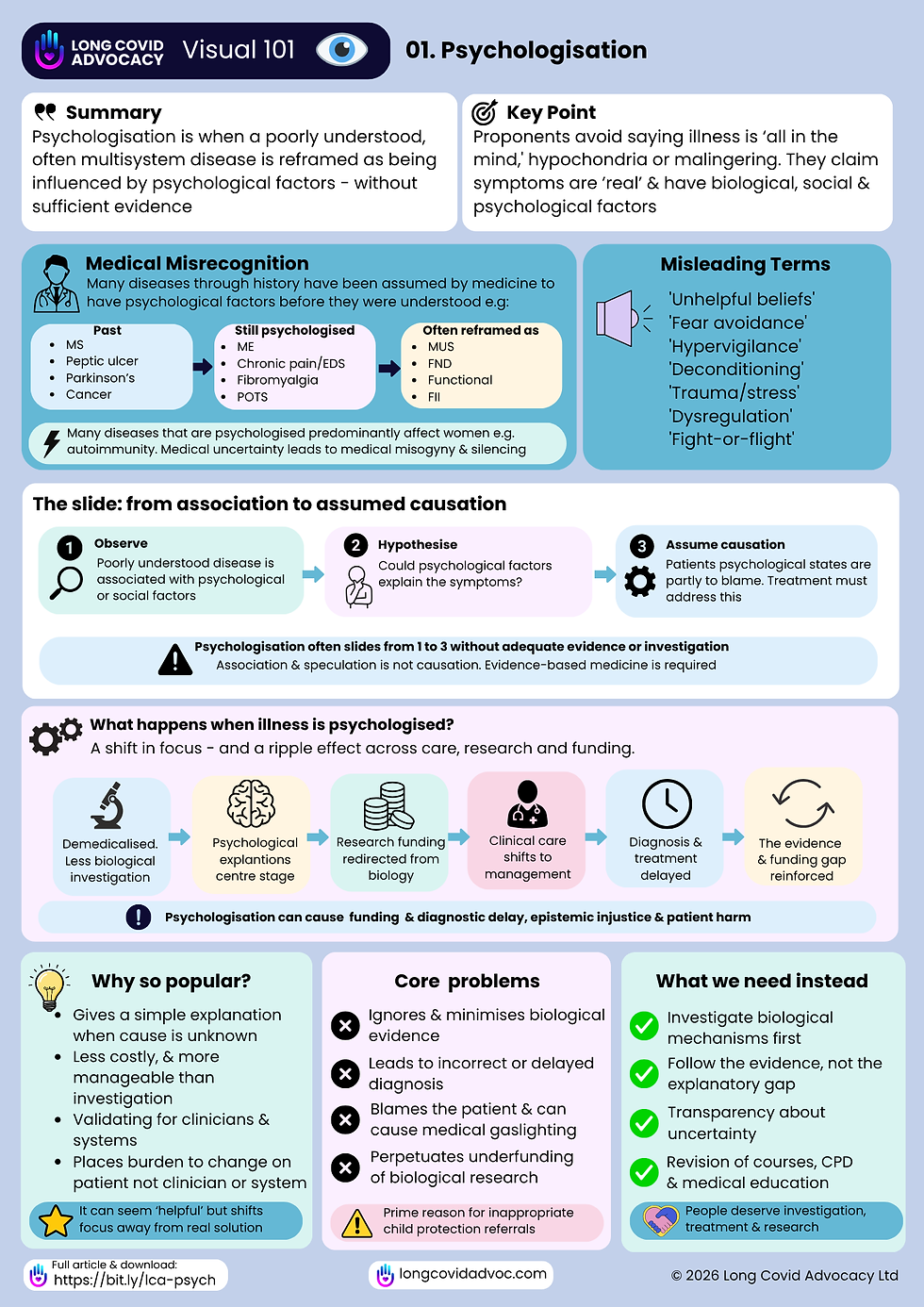
Infographic Out!
The Psychologisation Infographic is ready and available for you to download. This was our first article in the 101 series, and you can read the updated version here, as we have since finalised our infographic process. We also thought it would be helpful to go over some recent articles that show psychologisation is still highly relevant and embedded in medicine.
Today The Guardian reported on a study that demonstrated that women with autoimmunity are 74% more likely than men to be told that their symptoms are psychological. Shaista Tayabali, patient and co-author of the study stated:
The fact that females reported higher rates of psychiatric and psychosomatic misdiagnoses than males … suggests that historical gender biases remain a challenging aspect of the diagnostic journey … Although labels such as hysteria are outdated, and fortunately rarely used nowadays, as women we still often have a harder time having our symptoms believed and therefore addressed accurately.
This makes it clear that diseases that are poorly understood, often multisystemic and chronic, are at the highest risk of psychologisation, especially those that affect women. Yet, the reach of psychologisation is pernicious and can be attributed to diseases that often have a clearer understanding of the biology and even treatments.
What if we are Wrong?
It is also worth bringing attention to a Norwegian article, ‘Making recovery conceivable ’, about HCPs who use psychological treatments in ME. It’s a fascinating read, but shows the cracks that patient advocacy is bringing - doubt:
Some also expressed residual diagnostic uncertainty and concern about how current approaches might be viewed if future research were to establish a treatable biological dysfunction with little or no role for the processes they currently targeted. Several clinicians also reported being criticised for not believing patients or for minimising their suffering, highlighting the moral and professional stakes involved.
This is the key diagnostic question we examined in the original article - and the answer is obvious: their model collapses, and the reality that they are gaslighting and harming patients will be clear to see.
The Tendency to Double Down
Yet, the response to this uncertainty is often denial. They do not take these ‘counter-narratives’ seriously and double down. This is done by focusing on building trust in the ‘therapeutic relationship’ or, in other words, gaslighting compassion or persuasion. A process we have discussed in other articles.
They also reinforce a “new map” i.e the biopsychosocial model, that is decades old, recruit family to tell patients that pushing through symptoms is “not dangerous”, and advise caution about contacting patient organisations.
This predisposition to double down is not unique to these clinicians, we also saw two researchers in psychosomatic medicine and invested in the BPS model, Kupferschmitt and Köllner, publish an article in Springer Nature that called:
some patients with fatigue [were] combative and reproachful toward health care providers.
Although this was apparently added without their knowledge by psychiatrist Michael Linden. See David Tuller’s article for more details.
Historical Bias
A word of wisdom, though, for those that psychologise. Ensure that the treatment you are giving patients comes with sufficient evidence and that you are aware of and trained in the historical biases that are still active in medicine. And know that one day you will be shown to be very, very wrong.
Joint statement by the Psychotherapie Netwerk ME/CFS:
Such sweeping statements condense individual negative experiences into a supposed peculiarity of this patient group, while our experience in practice and research provides no basis for this whatsoever. Such portrayals can foster unfounded mistrust of those affected, encourage a premature psychologization of physical symptoms, and contribute to a lack of impartiality in medical assessments. This further complicates the already inadequate care provided to people with ME/CFS.
If you have been psychologised in medical appointments, please feel free to share your experience in the comments; patient testimony is important.
Note: Our next infographic is on its way and will be a guide on what to do if you are reinfected with Covid. We would also like to give a very grateful thank you to the people involved in reviewing the infographics and to our paid subscribers on Substack, you honestly make all the difference.


Comments